Schedule
| POSTER # | DAY | NAME | PRESENTATION TITLE |
| CLINICAL | |||
| 001 | 3 | Zeena-Britt Sanders | Bi-directional modulation of sensorimotor cortex during executed movements |
| 002 | 2 | Yuki Sakai | Possible Clinical Application of Decoded Neurofeedback to Treatment of Obsessive-compulsive Disorder |
| 003 | 1 | Yujiro Yoshihara | Functional connectivity-based neurofeedback for impaired working memory in schizophrenia |
| 004 | 1 | Yu Takagi | A Neural Marker of Obsessive-Compulsive Disorder from Whole-Brain Functional Connectivity |
| 005 | 2 | Xiaofu He | Connectivity-based Real-time fMRI Neurofeedback in Youth with a History of Major Depression |
| 006 | 1 | Toshinori Chiba | The approach to clinical application of DecNef for PTSD patients |
| 007 | 3 | David Marc Anton Mehler | Targeting the emotional brain – a Randomized Clinical Trial of realtime fMRI neurofeedback training in patients with depression |
| 008 | 2 | Tomohisa Asai | Normal aging in resting-state brain networks: Toward a connectivity-neurofeedback for the declined metacognition in elderly people |
| 009 | 3 | Tom Fruchtman | Neurofeedback intervention for Post Traumatic Stress Disorder (PTSD): Preliminary results from fMRI study of chronic PTSD patients |
| 010 | 2 | Teiji Kawano | Assessments of post-stroke aphasia and recovery with the resting state EEG phase synchrony index |
| 011 | 1 | Takashi Yamada | The challenge of ameliorating depressive symptoms using functional connectivity-based neurofeedback (FCNef) |
| 012 | 3 | Takashi Yamada | The search for “theranostic biomarker” in psychiatric disorders: for more understanding the disease mechanism and for providing tailor-made therapy |
| 013 | 2 | Takashi Itahashi | Normalization of altered functional connection by Real-time fMRI neurofeedback on adults with Autism Spectrum Disorder |
| 014 | 1 | Sujesh Sreedharan | Self Regulation of Broca’s and Wernicke’s areas using real-time functional MRI in stroke patients with expressive Aphasia |
| 015 | 3 | Stephen M LaConte | Real-time fMRI modulation of DMN is enhanced with cognitive behavioral therapy in depression |
| 016 | 2 | Stephen M LaConte | Cognitive improvement in TBI veterans after rtfMRI DMN neurofeedback |
| 017 | 3 | Masayuki Hirata | Clinical Application of Implantable Brain Machine Interfaces |
| 018 | 2 | Mikhail Yevgenievitch Melnikov | THE REAL TIME FMRI NEUROFEEDBACK FOR DEPRESSED PATIENTS COMPARED TO EEG NEUROFEEDBACK AND COGNITIVE-BEHAVIORAL THERAPY |
| 019 | 3 | Mohit Rana | Self-regulation of anterior insular cortex in nicotine addicted smokers |
| 020 | 1 | Naho Ichikawa | A classifier of melancholic depression with whole-brain resting-state connectivity. |
| 021 | 2 | Naho Ichikawa | Depressive rumination reduced by realtime fMRI neurofeedback of the posterior cingulate cortex (PCC) activity |
| 022 | 3 | Nana Morita Hayashi | Decoded neurofeedback training for steady-state visual evoked field in patients with spinal cord injury |
| 023 | 1 | Noriaki Hattori | Decoding neurofeedback training to improve hemiparesis after stroke – a pilot study |
| 024 | 1 | Noriaki Yahata | A small number of abnormal functional connections in the brain predicts adult autism spectrum disorder |
| 025 | 2 | Noriaki Yahata | Identification of antidepressant dose-related, resting-state functional connectivity as a novel therapeutic target in neurofeedback: a machine learning-based fMRI study |
| 026 | 3 | Oliver Bichsel | Deep brain electrode-guided neurofeedback in Parkinson’s disease |
| 027 | 1 | Patricia Vargas | Functional Near Infrared Spectroscopy neurofeedback for motor cortical inter-hemispheric inhibition training in stroke patients |
| 028 | 2 | Patricia Vargas | Self-regulation of functional connectivity between cerebellum and primary motor areas with real-time fMRI neurofeedback: Differential activation and motor performance |
| 029 | 3 | Ryohei Fukuma | Neurofeedback using DBS electrodes in subthalamic nucleus of patients with Parkinson’s disease |
| 030 | 1 | Shohei Tsuchimoto | Brain-Machine-Interface changes functional connectivity between sensory and motor cortices in chronic post-stroke patients with hemiplegia: An interim analysis of randomized control trial |
| 031 | 3 | Masaya Misaki | Individual difference in the effect of amygdala neurofeedback emotional training in combat-related PTSD |
| 032 | 1 | Masahiro Yamashita | A prediction model of working memory based on whole-brain resting-state functional connectivity |
| 033 | 3 | Marita Mariela Rance | Neurofeedback produces clinical improvement in obsessive-compulsive disorder that grows over time |
| 034 | 2 | Leena Subramanian | BRAINTRAIN consortium: Design principles of randomised controlled trials of real-time fMRI neurofeedback with a focus on alcohol dependence |
| 035 | 1 | Kota Utsumi | P300-based brain-machine interface applied to patients with Duchenne muscular dystrophy |
| 036 | 3 | Kathryn Dickerson | Using real-‐time fMRI neurofeedback as a tool for demonstrating therapeutic efficacy |
| 037 | 2 | Jinendra Ekanayak | Modulation of motor circuits in Parkinson’s disease – applying realtime fMRI neurofeedback learning in STN-DBS patients |
| 038 | 2 | Jeffrey Eilbott | Resting State Connectivity Predicts Neurofeedback Response in OCD |
| 039 | 1 | Jaime A Pereira | Functional connectivity changes with real-time fMRI neurofeedback in Autism |
| 040 | 3 | Hiroaki Fujimoto | fNIRS-mediated neurofeedback for cerebellar ataxia: potential for augmenting rehabilitation outcome |
| 041 | 2 | Giuseppe Lisi | Functional connectivity rsfMRI as a Biomarker of Mental Disorders |
| 042 | |||
| 043 | 1 | David Marc Anton Mehler | Supplementary motor area, but not primary motor cortex – Translating graded real-time fMRI neurofeedback training to middle cerebral artery stroke (MCA) patients |
| 044 | 2 | Andrei Savelov | Recovery of post stroke wrist function under simultaneous fMRI/EEG biofeedback |
| 045 | 1 | Andrea del Pilar Sanchez | BCI-neurofeedback training for increasing the connectivity of fronto-parietal networks involved in the conscious perception of emotional stimuli in schizophrenia. |
| NEURAL MECHANISM | |||
| 046 | 2 | Hiroaki Hashimoto | Swallowing-related oscillatory changes revealed by human electrocorticogram |
| 047 | 1 | Ishani Rajendra Thakkar | The effect of reward on brain self-regulation acquired through fNIRS neurofeedback |
| 048 | 2 | June Sic Kim | Discrimination of kinesthetic and visual motor imagery |
| 049 | 3 | Leon Skottnik | Involvement of the reward system during rtfMRI neurofeedback across various self-regulation tasks |
| 050 | 1 | Martin Klasen | fMRI neurofeedback of language networks in auditory verbal hallucinations |
| 051 | 2 | Masahiro Takamura | Deactivation of DMN nodes during DLPFC fMRI neurofeedback |
| 052 | 3 | Meena M. Makary | DMN Functional Connectivity Modulation after Self-regulation of the Primary Motor Cortex Activity with Motor Imagery: A Real-time fMRI Neurofeedback Study |
| 053 | 1 | Natalie Ebner | Use of real-time fMRI in studying the aging brain |
| 054 | 2 | Ranganatha Sitaram | Investigating the neural mechanism of brain self-regulation with simultaneous fMRI-EEG acquisition during rtfMRI neurofeedback |
| 055 | 3 | Wako Yoshida | Closed-loop pain relief control using fMRI multi-voxel decoder and reinforcement learning |
| 056 | 1 | Santiago Munoz-Moldes | Subjective evaluation of real-time fMRI-based neurofeedback performance |
| 057 | 2 | Shabnam Hakimi | Modeling VTA learning from real-time fMRI neurofeedback |
| 058 | 3 | Shingo Tanaka | Elucidating the role of the macaque lateral prefrontal cortex for the value-based decision making using the decoded neurofeeback |
| 059 | 1 | Yuji Mizuno | Changes of brain activity associated with brain-computer interface learning |
| 060 | 2 | Guilherme M. de O. Wood | fMRI neurofeedback training of the left insula mediates the outcome of EEG neurofeedback training of the sensorimotor rhythm (12-15 Hz) |
| 061 | 1 | Gabriele Ende | The functional neuroanatomy of neurofeedback control |
| 062 | 3 | Fabien LOTTE | What are the best motor tasks to use and calibrate SensoriMotor Rhythm Neurofeedback and Brain-Computer Interfaces? A preliminary case study |
| 063 | 2 | Catharina Zich | Dynamic fMRI-based neurofeedback under the microscope – evidence from the developing brain |
| 064 | 1 | Ryu Ohata | Decoding self-other action attribution in the sensorimotor and the parietal cortices |
| 065 | 2 | Amelie Haugg | Pre-training localizer activity predicts real-time fMRI neurofeedback learning success |
| COGNITION AND PERCEPTION | |||
| 066 | 1 | Takehito Ito | The effect of downregulating the ACC activity on the negativity bias: a preliminary investigation |
| 067 | 1 | Robert A Backer | Down-regulating physiological arousal in cognitively demanding contexts: A real-time neural feedback intervention |
| 068 | 3 | Megan T deBettencourt | Predicting memory encoding by tracking attention |
| 069 | 2 | Megan A. K. Peters | Improving functional connectivity to prefrontal cortex with decoded neurofeedback |
| 070 | 1 | Kouji Takano | Decoded neurofeedback training for steady-state visual evoked field |
| 071 | 3 | Jessica Elizabeth Taylor | An Investigation into the Ecological Validity of DecNef Fear Memory Counter-Conditioning |
| 072 | 2 | Jessica Elizabeth Taylor | A DecNef Investigation into the Dissociability of Phenomenal and Access Consciousness |
| 073 | 3 | JD Knotts | Using decoded fMRI neurofeedback to identify multivariate patterns for illusory color perception |
| 074 | 2 | Hannah Boeijkens | Toward improving motor and working memory function through functional near-infrared spectroscopy neurofeedback |
| 075 | 3 | Hyun-Chul Kim | Mediation analysis between triple networks reflects functional connectivity changes from a mindfulness training in real-time fMRI neurofeedback setting |
| 076 | 1 | Gustavo Pamplona | Improving attention through network-based neurofeedback training |
| 077 | 2 | Lydia Hellrung | rtQC: An open-source collaborative framework for quality control methods in real-time functional magnetic resonance imaging |
| 078 | 3 | Yury Koush | Hippocampal CA1 down-regulation performance as a biomarker of preclinical Alzheimer’s disease. |
| 079 | 1 | Ai Koizumi | Fear reduction without fear through reinforcement of neural activity that bypasses conscious exposure |
| 080 | 2 | Anne Mennen | Inhibiting scene memories through closed-loop modulation of retrieval strength |
| 081 | 3 | Aurelio Cortese | Adaptive significance of consciousness in reinforcement learning |
| 082 | 2 | Aurelio Cortese | Long-term within-subjects’ bidirectional confidence changes induced by multivoxel pattern manipulation |
| 083 | 1 | Ayako Isato | Preliminary examination of resting-state functional connectivity associated with the reduction of negativity bias after neurofeedback training |
| 084 | 2 | Brian Odegaard | Investigating the role of prefrontal cortex in conscious perception with decoded neurofeedback |
| 085 | 3 | Gunda Hanna Johannes | Neurofeedback-aided regulation of food cue reactivity in the dopaminergic midbrain |
| METHOD, THEORY, MATH | |||
| 086 | 1 | Zhen LIANG | EEG Alpha Oscillations Reveal Color Contrast: SVR-Based Modelling |
| 087 | 2 | Yusuke Takeda | Estimating repetitive spatiotemporal patterns from many subjects’ resting-state fMRI data |
| 088 | 3 | Yuto Okada | Simulation studies of deep-brain activity inference using fMRI-fNIRS |
| 089 | 2 | Yury Koush | OpenNFT: An open-source Python/Matlab framework for real-time fMRI neurofeedback training |
| 090 | 1 | Takeshi Ogawa | Prediction of resting state fMRI signatures from EEG signal: a study of EEG-fMRI simultaneous recording |
| 091 | 3 | Tabea Kamp | Localizing the default mode network for real-time purposes using seed-based analyses |
| 092 | 2 | Shuka Shibusawa | Establishing real-time adaptive transcranial alternating current stimulation (tACS) during whole-head magnetoencephalography (MEG) |
| 093 | 1 | Lydia Hellrung | Patterns of successfully regulating the dopaminergic midbrain |
| 094 | 3 | Rick van Hoof | Single trial letter imagery decoding in early visual cortex with high-field MRI |
| 095 | 1 | Rahim Malekshahi | A versatile toolbox for real-time EEG neurofeedback: Emphasis on source activity from auditory cortex in patients with chronic tinnitus |
| 096 | 3 | Michael Luehrs | Functional verification of fNIRS probe locations using a generalized SVM classifier model |
| 097 | 2 | Michael Luehrs | Retrieving fMRI data in real-time: difficulties and pitfalls |
| 098 | 1 | Michael Luehrs | Real-time MR-Encephalography for BCI/Neurofeedback applications |
| 099 | 2 | Okito Yamashita | VBMEG : Open-source software for MEG/EEG source localization and dynamics modeling |
| 100 | 3 | Lydia Hellrung | Motion and physiological noise effects on neurofeedback learning |
| 101 | |||
| 102 | 2 | Maro Machizawa | A simplified multi-axis affective and cognitive decoded neurofeedback system for anticipation of excitement |
| 103 | 3 | Klaus Mathiak | Intersubject covariance reveals patterns in neurofeedback dynamics and disturbances in psychiatric disorders |
| 104 | 2 | Kathy Louise Ruddy | Changing oscillatory brain state using TMS-based neurofeedback |
| 105 | 1 | Aapo Hyvarinen | Towards a neurofeedback system for mindfulness training based on detecting mind wandering |
| 106 | 2 | Abhishek Bhutada | Automatic digitization and labeling of EEG electrodes from MRI images for rapid coregistration for rtfMRI-EEG neurofeedback. |
| 107 | 1 | Ayumu Yamashita | Functional Connectivity Neurofeedback Training Can Differentially Change Functional Connectivity and Cognitive Performance |
| 108 | 3 | Ayumu Yamashita | Quantitative comparing the magnitude of measurement bias and sampling bias on multi-site resting-state fMRI connectivity with the magnitude of the effects of psychiatric disorders by using traveling subject design |
| 109 | 2 | Andrea del Pilar Sanchez | Close-loop training of attention using a low-cost EEG device |
| 110 | 1 | Caroline Benjamins | The (in)consistency among researchers when selecting a neurofeedback target region |
| 111 | 3 | Catalin Iourdan | KL-Evidence: A Novel Multivariate Neurofeedback Method for Differentiating Representations |
| 112 | 1 | Chiara Fioravanti | Estimation of perceptual thresholds in a neurofeedback paradigm: effects and corrections of observer bias |
| 113 | 3 | Diletta Rivela | On the development of EEG sensorimotor rhythm-based continuous proprioceptive neurofeedback |
| 114 | 2 | Epifanio Bagarinao | Use of a small humanoid robot as a neurofeedback system for motor imagery tasks |
| 115 | 3 | Hanna Lu | Intra-individual variability of head motion (IIV-HM): a novel index of in-scanner head motion and its associations with cognitive performance |
| 116 | 1 | Hiroki Moriya | Predictability of amygdala BOLD signal from multiple-electrode EEGs |
| 117 | 2 | Johan Nicolaas van der Meer | Image Distortion in 7 Tesla and its significance for high-field Amygdala neurofeedback |
| 118 | 3 | Judith Eck | Self-regulation of a functional network using real-time fMRI |
| 119 | 1 | Jun-ichiro Hirayama | Exploring EEG source resting-state networks by SPLICE: A simultaneous fMRI study |
| BRAIN-MACHINE INTERFACE | |||
| 120 | 1 | Tatsuya Teramae | A control strategy for physical human-robot interaction using biosignal-based model predictive control |
| 121 | 3 | Taro Kaiju | Induction of electrocorticography patterns via operant conditioning using a BMI self-feeding task |
| 122 | 2 | Shinya Chiyohara | Proprioceptive Gain Affects Motor Learning |
| 123 | 1 | Rytoaro Numata | Towards the development of a co-adaptive brain robot interface |
| 124 | 3 | Jun-ichiro Furukawa | Human Movement Estimation from Multiple Biosignal Observations toward Safe Assistive Robot Control |
| 125 | 2 | Bettina Sorger | An fNIRS-based brain-machine interface for remote robot control |
| 126 | 1 | Asuka Takai | The differences in motor performances between sensorimotor area activities of pre- and during passive guidance |
| EMOTION AND SENSORIMOTOR | |||
| 127 | 3 | Zhiying Zhao | Training the Emotion Regulation Circuit Using Functional Connectivity Based rt-fMRI Neurofeedback: Proof-of-Concept |
| 128 | 2 | Salim Al-Wasity | Empathy and the use of real-time fMRI to learn voluntary regulation of the anterior insula |
| 129 | 1 | Ronald Sladky | Closed-loop amygdala neurofeedback using emotional faces |
| 130 | 2 | Ronald Sladky | Brain networks underlying successful emotion regulation with rt-fMRI neurofeedback |
| 131 | 3 | Renate Schweizer | Extended rt-fMRI neurofeedback training of the somato-motor cortex reveals different learning outcomes |
| 132 | 1 | Ming Chang | Unconscious Improvement in Foreign Language Learning Using Mismatch Negativity Neurofeedback |
| 133 | 3 | Michael Marxen | The Influence of Amygdala Regulation on Emotional Reactivity |
| 134 | 1 | Doron Todder | Dissociating Arithmetic Functions Through Region–Specific EEG Neurofeedback Training: double-blind controlled study |
| 135 | 2 | Ethan Oblak | Motor sequence skill learning by operant conditioning of cortical activity |
| 136 | 3 | Frank Pollick | Enhancing Motor Reaction time using Real-Time Functional MRI Neurofeedback of Supplementary Motor Area (SMA) |
| 137 | 1 | Jackob Nimrod Keynan | Amygdala-NeuroFeedback improves emotion regulation and reduces vulnerability to mild military stress |
| 138 | 2 | Jana Zweerings | Impaired voluntary control of the emotion regulation network in PTSD: probing self-regulation with real-time fMRI |
| 139 | 3 | Jenny Katharina Zaehringer | Alterations of Emotion Regulation in Patients with Borderline Personality Disorder through Real-time fMRI Neurofeedback Training |
| 140 | 1 | Lulu Wang | Effects of real-time fMRI neurofeedback on behavioural outcome measures: A systematic review |
| 141 | 2 | Masaru Tanaka | Sense of agency altered by cognitive intervention affects motor control |
Layout:
 |
 |
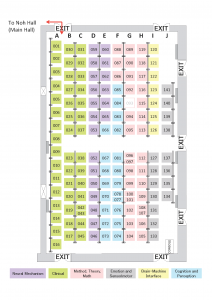
Day 1 (Nov. 29th): Poster # & layout
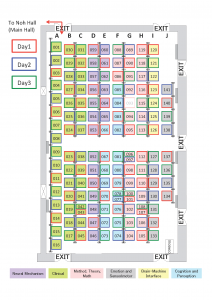
Day 2 (Nov. 30th): Poster # & layout
Day 3 (Dec. 1st): Poster # & layout